For years, Mumbai occupied a sacred place in our imagination. It was not merely a city; it was a declaration of ambition. To survive Mumbai was to prove something about ourselves. The crowds, the monsoon floods, the relentless pace, the exhausting commute—these were not inconveniences. They were symbols of worth.
Then we moved to Delhi.
Distance has a way of sharpening reality. What once felt like civic pride now appears, with uncomfortable clarity, as a long habit of excuse-making. Living in Delhi does not erase Mumbai’s energy, resilience, or emotional pull. But it reveals something many of us were unwilling to admit while living there: Mumbai has been failing its residents for decades, and loyalty often prevented us from saying it aloud.
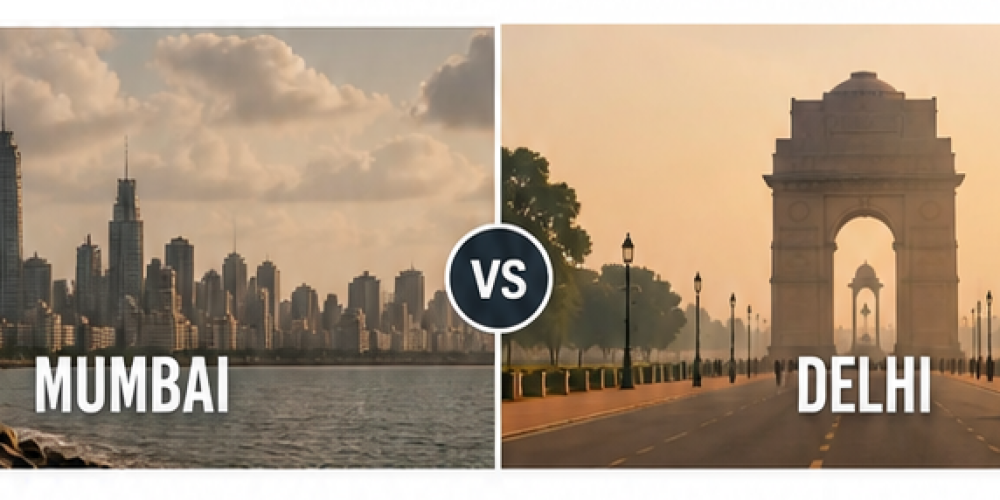
Mumbai vs Delhi: The Difference Between Survival and Urban Planning
The most immediate difference between the two cities is not cultural. It is structural.
In Delhi, the city feels designed for movement. Roads are wider, public transport is legible, and even when congestion appears, the broader framework suggests planning rather than improvisation.
In Mumbai, movement often feels like negotiation with a city perpetually stretched beyond its limits.
For generations, Mumbaikars learned to equate inconvenience with character. We told ourselves that waking at dawn to catch a crowded train, spending hours in traffic, and enduring crumbling infrastructure were simply the cost of belonging to India’s financial capital.
But once we experienced a city where movement felt less punishing, the contrast became impossible to ignore.
Delhi Metro vs Mumbai Metro: A Study in Civic Priorities
Perhaps nowhere is this contrast more visible than in urban transit.
Delhi Metro: A Functional Public Infrastructure Model
The Delhi Metro is one of modern India’s clearest examples of civic competence. It stretches across hundreds of kilometers, connecting residential zones, business districts, airports, markets, universities, and satellite towns with remarkable coherence.
The most striking aspect is not only its scale. It is the fact that it works.
Commuters rely on it not because they have no alternative, but because it is often the smartest option. It is air-conditioned, mostly punctual, integrated, and predictable—qualities that fundamentally shape urban life.
Mumbai Metro: A Promise Perpetually Under Construction
By contrast, the Mumbai Metro has long felt like an unfinished apology.
Construction sites have become permanent features of the landscape. Roads remain narrowed for years. Flyovers stand half-complete. Entire neighborhoods live with dust, congestion, and disrupted access while waiting for a future that keeps getting postponed.
The result is not merely inconvenience. It is a deeper civic failure: Mumbai’s residents continue to pay the daily cost of infrastructure delays without receiving the benefits of a truly integrated transport system.
Mumbai Local Trains and the Normalisation of Daily Risk
The Mumbai Suburban Railway remains the city’s lifeline.
It is also one of the clearest examples of how dysfunction becomes normalized.
For decades, millions have commuted packed into compartments far beyond safe capacity. Hanging out of doors, running across tracks, squeezing into spaces designed for far fewer people—these are not occasional images. They are daily reality.
And yet this reality has often been romanticized.
The language of Mumbai’s resilience has turned structural danger into civic mythology. Overcrowding became “the spirit of the city.” Dangerous travel became “grit.” Daily exhaustion became “hustle.”
What should have triggered outrage instead became identity.
Delhi’s Food Diversity Reveals What Cosmopolitanism Actually Means
One of the most unexpected revelations after moving to Delhi is food—not simply taste, but what food says about a city.
The Cultural Geography of Delhi’s Street Food
Delhi’s neighborhoods tell migration stories through cuisine.
Walk through Humayunpur, Munirka, or Laxmi Nagar, and the city reveals layers of settlement, adaptation, and continuity.
Among the most memorable examples are momos.
In these areas, especially where the North Eastern Indian diaspora has built enduring communities, momos are not fashionable snacks. They are living culinary inheritance. Served from steamers on busy sidewalks, paired with fiercely spiced chutney, they carry cultural depth far beyond their modest price.
Why Mumbai’s Cosmopolitan Identity Has Noticeable Gaps
Mumbai has extraordinary food. It has regional richness, street classics, and iconic neighborhoods.
Yet its self-image as India’s ultimate melting pot conceals absences.
The city never fully developed the same visible, thriving North Eastern cultural ecosystems found in Delhi. There are fewer concentrated culinary districts, fewer intergenerational migrant pockets that visibly shape everyday urban identity.
This matters because a truly cosmopolitan city is not defined merely by population diversity, but by whose presence becomes permanent and visible in the public fabric.
Delhi’s Green Spaces Change the Experience of Daily Life
Delhi carries a reputation for pollution, and deservedly so. Yet visually, spatially, and physically, it is also a green city.
That becomes obvious the moment one starts walking.
Urban Green Cover That Actually Exists
At Lodhi Garden, mornings unfold around joggers, readers, families, and office-goers finding a moment of calm before work.
Sanjay Van feels almost improbable—a forest embedded within metropolitan boundaries.
Even smaller neighborhood green zones matter. They soften the day. They lower urban aggression. They create psychological breathing space.
Mumbai’s Vanishing Open Spaces
Mumbai, by contrast, increasingly feels compressed.
Every patch of land seems contested. Every open space appears vulnerable to development pressure.
The struggle over Aarey Colony became emblematic of a deeper truth. Green spaces in Mumbai are rarely treated as civic necessities. They are treated as land banks waiting to be monetized.
The irony is almost unbearable. Residential towers rise with names invoking peace, gardens, and nature, even as actual public green space disappears.
This is not merely aesthetic loss.
It is a decline in urban quality of life.
The Spirit of Mumbai: Resilience or Political Convenience?
Few phrases are as emotionally powerful—or as politically useful—as “the Spirit of Mumbai.”
It emerges after floods.
It returns after infrastructure collapse.
It resurfaces after train disruptions, building failures, and civic breakdown.
At one level, it reflects something real. Mumbaikars do endure extraordinary hardship with uncommon determination.
But that truth has another side.
When Resilience Lowers Expectations
Resilience becomes dangerous when it lowers the threshold of what citizens demand.
If people return to work the day after flooding, governance is praised instead of questioned.
If commuters survive unbearable conditions, policymakers celebrate endurance rather than address causes.
If tragedy becomes routine, outrage fades.
That is the deeper cost of civic mythology.
The more heroic residents become, the easier it becomes for institutions to remain mediocre.
Delhi Is Not Perfect—But It Forces an Honest Comparison
Delhi is far from ideal.
The winter air can become hazardous. Concerns about women’s safety remain urgent. Infrastructure, beyond core zones, often frays.
Yet Delhi still exposes something uncomfortable: a city can be flawed and still offer citizens more visible evidence of planning, access, and public investment.
The difference is not perfection.
The difference is whether dysfunction feels exceptional or permanent.
In Mumbai, too often, dysfunction became background noise.
Why Leaving Mumbai Changed the Way We See It
Distance stripped away romance.
It became easier to separate emotional attachment from civic reality.
We still admire Mumbai’s ambition.
We still respect its energy.
We still understand why millions continue to love it fiercely.
But love cannot require denial.
A city that forces residents into punishing commutes, shrinking living space, deteriorating public infrastructure, and vanishing open land while asking them to call it resilience is not simply demanding—it is under-serving the very people who keep it alive.
That is not betrayal.
That is clarity.
Mumbai Deserves Better Than Mythology
The hardest truth after moving from Mumbai to Delhi is not that Delhi is superior in every way.
It is that Mumbai could have been better long ago.
Its residents have contributed enough.
They have tolerated enough.
They have adapted enough.
For too long, the city’s mythology has protected its failures.
Mumbai does not need more romanticism.
It needs accountability.
It needs infrastructure worthy of its economic importance.
It needs public spaces protected from speculative development.
It needs transportation systems built for dignity rather than endurance.
And above all, it needs citizens who can love it without defending what has never been acceptable.
Missing Mumbai is natural.
Pretending it works as it should is not.